

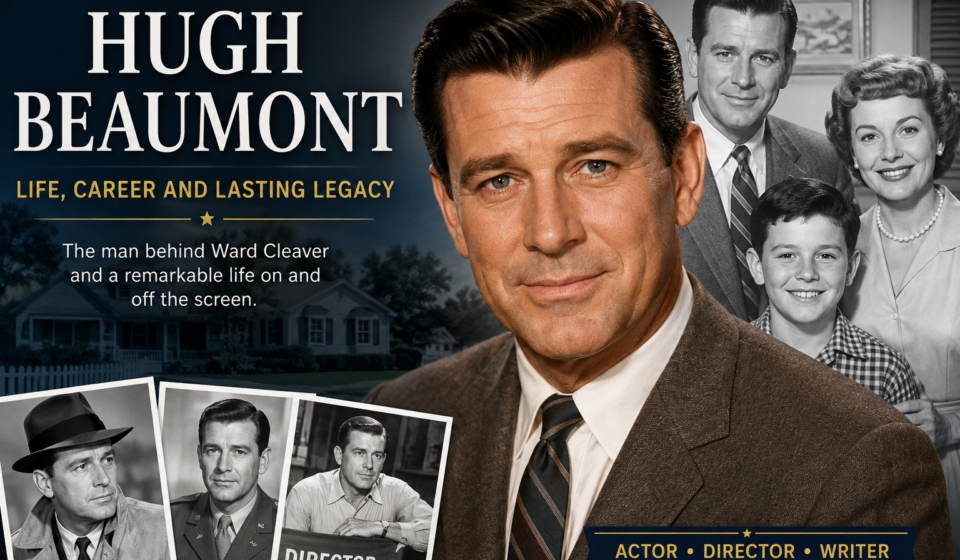

Hugh Beaumont: Life, Career and Lasting Legacy
Hugh Beaumont remains one of classic American television’s most recognizable father figures. Best known for playing Ward Cleaver on Leave It to Beaver, Beaumont helped define the image of the thoughtful, steady television father during the late 1950s and early 1960s.
Yet his career was much broader than the role that made him famous. Before Leave It to Beaver, Beaumont worked in theater, radio, and films, including crime pictures and film noir. He also worked as a writer and director and maintained a connection to religious ministry throughout his professional life.
His story is especially interesting because acting was only one part of his identity. His education in theology, work as a Methodist minister, experiences during World War II, and later involvement in directing and community activities reveal a more complicated figure than the familiar image of Ward Cleaver might suggest.
This article explores Hugh Beaumont’s early life, education, acting career, Leave It to Beaver years, family, religious work, later life, and enduring legacy.
Key Takeaways
- Hugh Beaumont was born on February 16, 1909, in Lawrence, Kansas, and died on May 14, 1982, in Munich, Germany.
- He became internationally recognized for playing Ward Cleaver in Leave It to Beaver from 1957 to 1963.
- Before television fame, Beaumont worked in theater, radio, and numerous Hollywood films.
- He played private detective Michael Shayne in a series of films during the 1940s.
- Beaumont studied theology and maintained an important connection to Methodist ministry alongside his entertainment career.
- His work as Ward Cleaver helped establish one of classic television’s enduring portrayals of an American father.
Biography Table
| Detail | Information |
|---|---|
| Full Name | Eugene Hugh Beaumont |
| Date of Birth | February 16, 1909 |
| Age at Death | 73 |
| Birthplace | Lawrence, Kansas, United States |
| Nationality | American |
| Profession | Actor, television director, writer |
| Education | University of Chattanooga; University of Southern California |
| Years Active | 1931–1972 in entertainment and related work |
| Known For | Ward Cleaver in Leave It to Beaver |
| Major Achievements | Television acting, film roles, directing and writing |
| Estimated Net Worth | Not reliably documented |
The Kansas Historical Society identifies Lawrence, Kansas, as Beaumont’s birthplace and May 14, 1982, as his date of death in Munich. It also notes that he attended the University of Chattanooga before studying at the University of Southern California.
Hugh Beaumont’s Early Life
Eugene Hugh Beaumont was born on February 16, 1909, in Lawrence, Kansas. His early years helped shape a life that would eventually combine entertainment, education, and religious interests.
As a young man, Beaumont attended the University of Chattanooga, where he played football. He later continued his education at the University of Southern California, where he earned a master’s degree in theology in 1946. His academic background was unusual for an actor and became an important part of his identity outside Hollywood.
Beaumont’s interest in performance developed before his major film and television roles. According to biographical records, he began working in show business in 1931, appearing in theater productions, nightclubs, and radio.
That early experience gave him a foundation in several forms of performance rather than limiting him to one medium.
Education and Religious Life
One of the most overlooked aspects of Hugh Beaumont’s life was his religious background.
His theological education was not simply a footnote. Beaumont was connected with Methodist ministry and continued religious work while pursuing his acting career. This dual identity helps explain why his professional life did not follow the typical Hollywood path.
His faith also influenced how he viewed acting. Beaumont reportedly regarded his work as an actor alongside his responsibilities and ideals as a clergyman. That tension between entertainment and personal values became part of his broader philosophy about his career.
His theological education also adds context to Ward Cleaver. Although the fictional character was not simply a reflection of Beaumont himself, Beaumont brought a measured, serious presence to the role that suited the character’s position as a father and moral guide.
Hugh Beaumont’s Acting Career Before Leave It to Beaver
Before becoming Ward Cleaver, Beaumont built a substantial résumé in film and television.
His entertainment career began in theater and radio before he moved into film work during the 1940s. He appeared in a wide variety of productions, including crime dramas, war films, thrillers, and film noir.
Some of his notable early film appearances included:
- The Seventh Victim (1943)
- The Blue Dahlia (1946)
- Murder Is My Business (1946)
- Railroaded! (1947)
- Bury Me Dead (1947)
- The Lost Continent (1951)
- The Mole People (1956)
- Night Passage (1957)
These roles show how different Beaumont’s early screen career was from the wholesome suburban image he would eventually become associated with.
Michael Shayne and Film Noir
An especially interesting chapter in Beaumont’s career came when he portrayed private detective Michael Shayne.
During 1946 and 1947, Beaumont appeared as Shayne in a series of low-budget mystery films. The role allowed him to work within the crime and detective genre, which was far removed from the family sitcom atmosphere of Leave It to Beaver.
This period demonstrated Beaumont’s versatility. Audiences who later knew him primarily as Ward Cleaver might not have immediately associated him with the harder-edged detective roles of his earlier career.
Hugh Beaumont and Leave It to Beaver
The defining role of Hugh Beaumont’s career arrived in 1957 when he was cast as Ward Cleaver on Leave It to Beaver.
The sitcom followed Theodore “Beaver” Cleaver, played by Jerry Mathers, and his family. Beaumont played Ward, the father, while Barbara Billingsley played June Cleaver.
The series originally ran from 1957 through 1963 and became one of the most recognizable family sitcoms in American television history. Beaumont appeared as Ward Cleaver throughout the series, making the character central to his public image.
Why Ward Cleaver Became So Memorable
Ward Cleaver represented a particular television ideal of fatherhood.
He was generally portrayed as calm, responsible, and willing to listen. Rather than solving every problem through anger or punishment, Ward often tried to understand what had happened before deciding how to respond.
That approach helped distinguish the character from some of the more authoritarian fathers seen in earlier entertainment.
Beaumont’s restrained performance was crucial. He did not need exaggerated reactions to communicate authority. His voice, posture, timing, and understated expressions gave Ward a sense of credibility.
The character also worked because he was not presented as perfect. Family disagreements, misunderstandings, and everyday mistakes gave the Cleavers recognizable problems to solve.
As a result, Hugh Beaumont became strongly associated with the classic television father figure.
Beaumont Was More Than an Actor on Leave It to Beaver
Beaumont’s contribution to Leave It to Beaver extended beyond acting.
He also directed episodes of the series and contributed as a writer. IMDb lists him as an actor, director, and writer, with credits that include work connected to the series.
That involvement is important when considering his legacy because it shows that Beaumont was not simply a performer who arrived on set and delivered dialogue.
He understood the production process from multiple perspectives.
His work behind the camera also demonstrated his interest in storytelling and the broader creative side of television. The ability to move between acting, directing, and writing was particularly valuable during an era when television production was rapidly expanding.
Hugh Beaumont’s Family Life
Beaumont married actress Kathryn Adams in 1941, and the couple had three children. Their marriage eventually ended in divorce in 1974.
His family life remained separate from much of the public image created by Leave It to Beaver. This distinction matters because Ward Cleaver was a fictional character, while Beaumont’s personal life had its own complexities.
His children included Hunter Beaumont, Mark Beaumont, and Kristy Beaumont. Beaumont later spent time in Europe visiting his son Hunter, who was living in Germany.
Because Beaumont generally maintained a relatively private personal life, reliable biographical information about his family is more limited than the extensive material available about his television career.
Hugh Beaumont’s Work During World War II
Beaumont’s religious convictions also influenced his experience during World War II.
Biographical records identify him as a conscientious objector. Rather than serving as a conventional combatant, he served as a medic.
This aspect of his life provides another important perspective on the man behind the screen persona.
His decision reflected a personal and religious position while still allowing him to contribute through medical service. It also illustrates why Beaumont’s theological background should not be treated as a minor detail in his biography.
His career choices were connected to a broader set of values that existed independently of Hollywood.
Hugh Beaumont After Leave It to Beaver
When Leave It to Beaver ended in 1963, Beaumont continued working in television.
He made appearances in programs such as Petticoat Junction and The Virginian, among other television productions.
However, his career gradually changed direction.
Rather than continuing to pursue acting at the same pace, Beaumont increasingly devoted attention to other interests, including religious and community activities. His television career had already given him a lasting place in popular culture, but he did not spend the rest of his life trying to recreate the success of Ward Cleaver.
That decision is an important part of his story. For Beaumont, entertainment was one element of a broader life rather than the sole definition of his identity.
Hugh Beaumont’s Health and Final Years
In 1972, Beaumont suffered a stroke. The event significantly affected his health and contributed to the decline of his acting career. The Kansas Historical Society notes that he suffered the stroke in 1972.
Accounts of his later years indicate that he recovered beyond the grim expectations initially associated with the stroke and was able to participate in some directing and community theater activities.
His ability to remain involved in creative work after such a serious medical event reflected considerable determination.
How Did Hugh Beaumont Die?
Hugh Beaumont died on May 14, 1982, in Munich, Germany. He was 73.
The Kansas Historical Society states that Beaumont was visiting his son in Munich when he suffered a heart attack and died.
His death marked the end of a career that had stretched across theater, radio, film, and television.
Hugh Beaumont’s Most Notable Screen Work
Although Ward Cleaver remains his defining role, Beaumont’s filmography demonstrates considerable range.
| Work | Year | Role or Significance |
|---|---|---|
| The Seventh Victim | 1943 | Early film work |
| The Blue Dahlia | 1946 | Film noir appearance |
| Murder Is My Business | 1946 | Michael Shayne |
| Railroaded! | 1947 | Crime/noir role |
| The Lost Continent | 1951 | Adventure film |
| The Mole People | 1956 | Science-fiction role |
| Night Passage | 1957 | Western with James Stewart |
| Leave It to Beaver | 1957–1963 | Ward Cleaver |
His screen work reveals an actor who moved comfortably among genres. His career included noir, mystery, war, adventure, science fiction, Westerns, and family television.
The Lasting Legacy of Hugh Beaumont
Why does Hugh Beaumont continue to attract interest decades after his death?
The simplest answer is Ward Cleaver. Leave It to Beaver has remained part of the cultural memory of classic American television, and Beaumont’s performance is inseparable from the show’s identity.
But his legacy is broader than one sitcom.
A Defining Television Father
Ward Cleaver became a reference point for television fatherhood. His calm approach to family problems influenced the way later audiences remembered the idealized suburban father.
Beaumont’s performance was particularly effective because it relied on restraint. He gave Ward authority without making him unnecessarily intimidating.
A Versatile Career
His earlier film work is another reason his career deserves attention.
The contrast between Beaumont’s noir and detective roles and his later portrayal of Ward Cleaver demonstrates the breadth of his acting career. He was capable of moving between dramatically different genres and character types.
A Multidimensional Public Figure
Beaumont’s education, religious work, military-era service, directing, writing, and community involvement make his biography more substantial than a simple celebrity profile.
He was an actor, but acting did not define every part of his life.
Why Hugh Beaumont Still Matters
Classic television remains popular because older programs often provide a window into how previous generations understood family, work, authority, and everyday life.
Leave It to Beaver is particularly useful in that respect. Watching Ward Cleaver today allows audiences to compare mid-20th-century ideas about parenting with modern expectations.
At the same time, Beaumont’s personal story reminds us that actors can have lives and identities far more complicated than their most famous characters.
His transition from early film roles to Ward Cleaver, combined with his theological education and later work, makes him an interesting example of a performer whose professional identity evolved over several decades.
Frequently Asked Questions
Who was Hugh Beaumont?
Hugh Beaumont was an American actor, director, and writer best known for playing Ward Cleaver on the classic television sitcom Leave It to Beaver, which ran from 1957 to 1963.
When was Hugh Beaumont born?
Hugh Beaumont was born on February 16, 1909, in Lawrence, Kansas.
How old was Hugh Beaumont when he died?
Beaumont was 73 years old when he died on May 14, 1982.
What was Hugh Beaumont famous for?
He was most famous for portraying Ward Cleaver, the father of the Cleaver family, on Leave It to Beaver. The role became his defining television performance.
Was Hugh Beaumont a minister?
Beaumont studied theology at the University of Southern California and maintained a connection with Methodist ministry. His religious life existed alongside his entertainment career.
What movies did Hugh Beaumont appear in?
Among his film credits are The Seventh Victim, The Blue Dahlia, Murder Is My Business, Railroaded!, The Mole People, and Night Passage.
Did Hugh Beaumont direct Leave It to Beaver?
Yes. Beaumont directed episodes of Leave It to Beaver in addition to playing Ward Cleaver.
How did Hugh Beaumont die?
Hugh Beaumont died from a heart attack in Munich, Germany, on May 14, 1982, while visiting his son.
Conclusion
Hugh Beaumont built a career that reached far beyond his most famous television character. From theater and radio to film noir, detective movies, television, directing, writing, and religious ministry, his life reflected several distinct interests and professional identities.
His portrayal of Ward Cleaver ultimately became his greatest legacy. On Leave It to Beaver, Beaumont created a father who was composed, thoughtful, and authoritative without being defined solely by strict discipline. That performance helped make the series a lasting part of American television history.
Yet understanding Hugh Beaumont only through Ward Cleaver leaves out much of what made his life distinctive. His theological education, wartime service as a medic, film career, work behind the camera, family life, and resilience after his stroke all add important dimensions to his story.
More than four decades after his death, Beaumont continues to be remembered because his most famous performance captured an enduring television archetype. But his broader career shows that the man behind Ward Cleaver was considerably more versatile and complex than the character audiences came to know.