

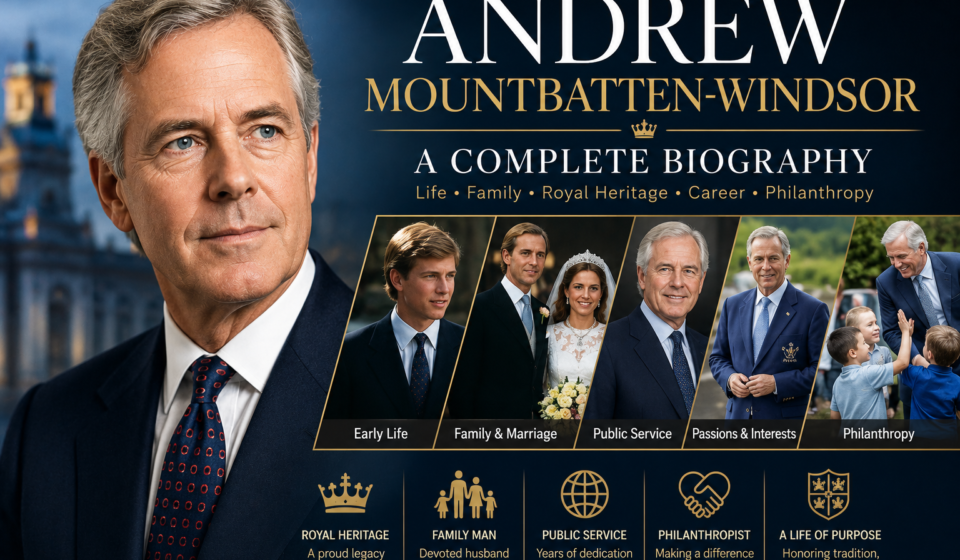

Andrew Mountbatten-Windsor: A Complete Biography
Andrew Mountbatten-Windsor is a member of the British royal family whose life has included military service, official royal duties, international diplomacy, family responsibilities, and intense public scrutiny. Born in 1960 as Prince Andrew, he is the second son of Queen Elizabeth II and Prince Philip, Duke of Edinburgh, and the younger brother of King Charles III.
His career initially followed a familiar path for a senior member of the Royal Family. He served in the Royal Navy, including active service during the Falklands War, and later represented the Crown through diplomatic and trade-related responsibilities. For many years, he was also known by the title Duke of York.
His public position changed dramatically in the late 2010s and again in 2025. After stepping back from public duties, he announced in October 2025 that he would no longer use his title or honours. Buckingham Palace subsequently announced that the formal process to remove his styles, titles and honours had begun and that he would be known as Andrew Mountbatten Windsor.
This biography examines Andrew Mountbatten-Windsor from his early life and naval career to his royal responsibilities, family, changing public role, and the developments that have reshaped his place within the modern monarchy.
Key Takeaways
- Andrew Mountbatten-Windsor was born on February 19, 1960, at Buckingham Palace.
- He served in the Royal Navy and was an active participant in the Falklands War.
- He married Sarah Ferguson in 1986, and they have two daughters, Princess Beatrice and Princess Eugenie.
- His career included royal representation, international trade promotion, and diplomatic responsibilities.
- He stepped back from public duties in 2019 and relinquished the use of his title and honours in 2025.
- Buckingham Palace announced in October 2025 that he would be known as Andrew Mountbatten Windsor and that a formal process to remove his styles, titles and honours had begun.
Biography Table
| Detail | Information |
|---|---|
| Full Name | Andrew Mountbatten Windsor |
| Date of Birth | February 19, 1960 |
| Age | 66 as of August 2026 |
| Birthplace | Buckingham Palace, London, United Kingdom |
| Nationality | British |
| Profession | Former naval officer and former working member of the British Royal Family |
| Education | Gordonstoun; Britannia Royal Naval College |
| Years Active | Royal Navy service and public royal duties from the late 1970s onward |
| Known For | Royal family membership, Royal Navy service, Falklands War service, international trade work and former title as Duke of York |
| Major Achievements | Naval aviation career, active military service, official overseas representation and trade promotion |
| Estimated Net Worth | No reliably established public figure |
Main Article
Who Is Andrew Mountbatten-Windsor?
Andrew Mountbatten-Windsor is the former Prince Andrew and the second son of Queen Elizabeth II and Prince Philip, Duke of Edinburgh.
For much of his adult life, the public knew him as Prince Andrew, Duke of York. His position was significant because he was a close member of the immediate royal family and undertook official responsibilities on behalf of the Crown.
His identity changed considerably in 2025. In October of that year, Buckingham Palace announced that the formal process to remove his style, titles and honours had begun. The statement said he would be known as Andrew Mountbatten Windsor.
The change makes understanding his biography especially important because his life spans several different phases: royal childhood, military service, marriage and family life, official duties, withdrawal from public life, and a subsequent change in his formal status.
Early Life and Royal Family Background
Andrew was born on February 19, 1960, at Buckingham Palace. He was the third child and second son of Queen Elizabeth II and Prince Philip.
His birth took place during the reign of his mother, who had become queen in 1952. As a child, Andrew grew up within one of the world’s most recognizable royal households.
His older siblings were King Charles III and Princess Anne, while his younger brother was Prince Edward, now the Duke of Edinburgh.
Growing up as the son of the monarch meant that Andrew’s childhood differed substantially from that of most people. Royal protocol, public appearances and constitutional responsibilities were part of his environment from an early age.
At the same time, he was not expected to inherit the throne. His position in the succession meant that his future role was more likely to involve supporting the monarch through military service, charitable work and official representation.
Education and Preparation for Military Service
Andrew attended Gordonstoun, the Scottish boarding school also attended by his father and older brother.
Rather than immediately entering a conventional university career, he followed a path that ultimately led to the Royal Navy. His military education and training prepared him for a career in naval aviation.
He joined the Royal Navy in the late 1970s and trained as a helicopter pilot. That decision became one of the defining elements of his early adult life.
His military career also distinguished him from some other members of his generation of the Royal Family because his service included active combat.
Andrew Mountbatten-Windsor and the Royal Navy
Andrew’s naval career is an important part of his biography because it established his public identity before many of his later royal controversies.
He trained as a helicopter pilot and served aboard Royal Navy vessels. His most significant period of military service came during the Falklands War in 1982.
Andrew flew helicopter missions during the conflict and served aboard HMS Invincible. His duties included roles connected with anti-submarine warfare, search and rescue, and casualty evacuation.
His participation in the Falklands War gave him direct operational experience and contributed to his reputation at the time as a serving member of the armed forces rather than simply a royal undertaking ceremonial duties.
His military career continued after the conflict, and he eventually reached the rank of commander.
The Falklands War
The Falklands War became one of the most important chapters in Andrew’s early public life.
The conflict began in 1982 after Argentina invaded the Falkland Islands, leading the United Kingdom to send a military task force to retake the territory.
Andrew was among the Royal Navy personnel involved in the British operation. His service made him one of the more prominent members of the Royal Family to have experienced active military duty in the modern era.
The experience also shaped his later public identity. Military service was frequently emphasized in accounts of his early career, particularly because he had undertaken operational duties rather than serving solely in ceremonial positions.
Marriage to Sarah Ferguson
In 1986, Andrew married Sarah Ferguson, who became widely known as the Duchess of York.
Their wedding attracted substantial international attention. The couple subsequently had two daughters:
- Princess Beatrice
- Princess Eugenie
Andrew and Sarah divorced in 1996, but they remained connected through their children and have continued to appear together publicly at various family occasions.
Their daughters have subsequently established their own careers and families, giving Andrew a continuing role within the wider royal family as a father and grandfather.
Family and Children
Family has remained an important part of Andrew’s public biography.
His two daughters, Beatrice and Eugenie, are both members of the wider British royal family. Their positions also mean that Andrew remains connected to the succession and to several generations of the Windsor family.
The Royal Family’s official succession list currently places Andrew Mountbatten-Windsor eighth in line to the British throne. Princess Beatrice follows him, with other members of the family continuing down the list.
This illustrates an important distinction: losing or relinquishing royal styles and honours does not automatically mean that every constitutional aspect of a person’s position changes in the same way. Succession is governed by constitutional rules and legislation rather than simply by personal titles.
Career as a Working Royal
After leaving active naval service, Andrew increasingly focused on his responsibilities as a member of the Royal Family.
One of the major areas associated with his public career was international trade.
He served as the UK’s Special Representative for International Trade and Investment and undertook overseas visits designed to promote British commercial interests.
This role gave him contact with governments, businesses and entrepreneurs around the world.
For a period, his work represented an attempt to use his position within the Royal Family to support British economic interests. He also became associated with initiatives intended to encourage entrepreneurship and business development.
His career therefore developed through several distinct stages:
- Royal childhood and education
- Royal Navy service
- Active military service
- Royal and diplomatic representation
- International trade promotion
- Withdrawal from public duties
Why Andrew Stepped Back From Public Life
Andrew’s public role changed significantly in 2019.
Following intense public controversy surrounding his relationship with Jeffrey Epstein and questions raised about his conduct, Andrew announced that he would step back from public duties.
In his statement at the time, he said the circumstances surrounding his former association with Epstein had become a major disruption to the work of the Royal Family.
His decision effectively ended his role as a regularly working member of the monarchy.
It is important to distinguish between allegations, public controversy and established legal findings. Andrew has denied allegations against him, and responsible accounts should not present allegations as proven facts.
The 2025 Change in His Royal Status
A further major change occurred in 2025.
In October, Andrew announced that he would no longer use his title or the honours that had been conferred upon him. He said the continued accusations against him were distracting from the work of the King and Royal Family and reiterated his denial of the allegations.
Later that month, Buckingham Palace announced that King Charles III had initiated a formal process to remove Andrew’s style, titles and honours. The Palace stated that he would be known as Andrew Mountbatten Windsor and that he would move from Royal Lodge to alternative private accommodation.
This development represented a major break from the status he had held for most of his adult life.
Why the Name Matters
The surname is closely connected to the history of the British Royal Family.
The House of Windsor was adopted as the royal family’s official name in 1917. In 1960, Queen Elizabeth II and Prince Philip established Mountbatten-Windsor as the surname used by certain descendants when a surname was required.
The name therefore reflects both sides of Andrew’s immediate family background: Windsor through the royal house and Mountbatten through his father’s family.
The official 2025 announcement uses the form Andrew Mountbatten Windsor, without the hyphen, following the removal of his former royal style.
Andrew Mountbatten-Windsor and the Royal Succession
One frequently misunderstood aspect of Andrew’s current position concerns the line of succession.
The Royal Family’s official succession information currently lists Andrew Mountbatten-Windsor at number eight.
The people ahead of him include the Prince of Wales and his children, followed by the Duke of Sussex and his children.
Being listed in the succession should not be confused with being a working royal or holding a royal title. These are separate concepts.
The constitutional rules governing succession are based on legislation and established constitutional arrangements. The Royal Family explains that Parliament has played a central role in regulating succession to the Crown.
2026 Developments
Andrew’s public situation remained subject to further scrutiny in 2026.
In February 2026, King Charles issued a statement referring to news concerning Andrew Mountbatten-Windsor and suspicion of misconduct in public office. The King emphasized that the appropriate authorities should conduct the investigation and that the law should take its course.
Because this is an ongoing legal and investigative matter, it is important to avoid treating suspicion or allegations as established wrongdoing. The appropriate distinction is between what authorities are investigating, what individuals have alleged, and what has been legally established.
This distinction is particularly important when writing about public figures whose circumstances remain subject to official processes.
Andrew Mountbatten-Windsor’s Relationship With the Modern Monarchy
Andrew’s story reflects some of the wider challenges faced by the modern British monarchy.
For decades, members of the Royal Family were generally expected to combine public service, charitable work, military responsibilities and ceremonial representation.
Andrew followed that model during much of his early career.
However, the standards applied to public figures have changed significantly. Questions about accountability, institutional reputation and associations with controversial individuals can have consequences for royal roles even when those individuals are not working members of the monarchy.
Andrew’s withdrawal from public duties and subsequent loss of royal styles demonstrate how dramatically a prominent royal position can change.
What Is Andrew Mountbatten-Windsor Doing Now?
Andrew no longer performs the regular public duties associated with being a working member of the Royal Family.
Following the changes announced in 2025, he is known as Andrew Mountbatten Windsor rather than by his former royal title. Buckingham Palace also stated that he would leave Royal Lodge for alternative private accommodation.
His current public profile is therefore substantially different from the one he had during his years as a working royal.
At the same time, he remains connected to the Royal Family through his birth, his daughters and his place in the official succession.
Does Andrew Mountbatten-Windsor Have a Net Worth?
There is no sufficiently reliable public figure that can be presented as a definitive net worth for Andrew Mountbatten-Windsor.
Online estimates often combine assumptions about property, inherited wealth, family resources, pensions, investments and other assets. Such calculations can be highly speculative.
For that reason, a responsible biography should avoid presenting a precise net-worth figure unless it can be supported by reliable financial documentation.
It is also important to distinguish personal wealth from the finances of the Crown Estate, royal residences and other assets associated with the institution of the monarchy. Those categories are not interchangeable.
Understanding the Different Names Used for Andrew
Readers may encounter several names when researching the same person.
Prince Andrew
This was the name most commonly used throughout his public life as a member of the Royal Family.
Duke of York
Andrew received the title Duke of York upon his marriage in 1986. He was widely known publicly by this title for decades.
Andrew Mountbatten Windsor
Following the changes announced in October 2025, Buckingham Palace stated that he would be known by this name.
Andrew Mountbatten-Windsor
This hyphenated spelling remains widely used in searches and historical references, including the primary keyword for this article. The official 2025 Palace statement, however, used Andrew Mountbatten Windsor without a hyphen.
Understanding these variations helps explain why searches for Andrew can produce information published under different names and titles.
Frequently Asked Questions
Who is Andrew Mountbatten-Windsor?
Andrew Mountbatten-Windsor is the former Prince Andrew, second son of Queen Elizabeth II and Prince Philip. He served in the Royal Navy and later undertook official royal and international trade responsibilities.
When was Andrew Mountbatten-Windsor born?
He was born on February 19, 1960, at Buckingham Palace in London.
Is Andrew Mountbatten-Windsor still a prince?
Following the formal process announced by Buckingham Palace in 2025, Andrew is no longer to use his former royal style and is known as Andrew Mountbatten Windsor.
Who are Andrew Mountbatten-Windsor’s children?
He has two daughters, Princess Beatrice and Princess Eugenie, from his marriage to Sarah Ferguson.
Did Andrew Mountbatten-Windsor serve in the military?
Yes. He served in the Royal Navy and trained as a helicopter pilot. He also saw active service during the Falklands War in 1982.
Why did Andrew leave public royal duties?
Andrew stepped back from public duties in 2019 following controversy surrounding his association with Jeffrey Epstein and questions about his conduct. He has denied allegations against him.
Is Andrew Mountbatten-Windsor still in the line of succession?
Yes. The official Royal Family succession list currently places Andrew Mountbatten-Windsor eighth in line to the throne.
What is Andrew Mountbatten-Windsor’s current status?
He is no longer a working member of the Royal Family and no longer uses his former royal title. Buckingham Palace announced in 2025 that he would be known as Andrew Mountbatten Windsor. His circumstances also remained subject to official investigation in 2026.
Conclusion
The biography of Andrew Mountbatten-Windsor covers far more than his former position within the British monarchy. His life has included a distinctive naval career, active military service during the Falklands War, marriage and parenthood, international trade responsibilities, and years of official royal representation.
It has also become a story of significant institutional change.
The man once widely known as Prince Andrew and the Duke of York stepped away from public duties in 2019. In 2025, he went further by relinquishing the use of his title and honours, while Buckingham Palace announced the formal process to remove his styles, titles and honours and stated that he would be known as Andrew Mountbatten Windsor.
His place in the Royal Family remains complicated. He continues to appear in the official line of succession, while his public role is fundamentally different from the one he held earlier in life.
As developments continue, the most reliable way to understand Andrew Mountbatten-Windsor is to separate his documented biography from allegations and ongoing investigations. His story illustrates how military service, royal duty, family connections, public accountability and changing constitutional conventions can intersect in the life of a modern British royal.